Museum News 2012
January 2012
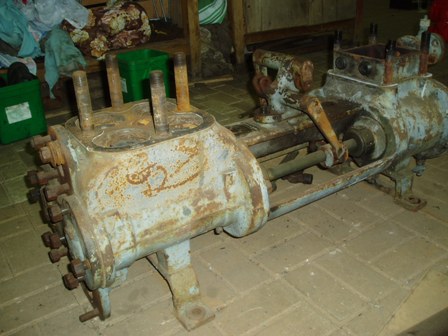
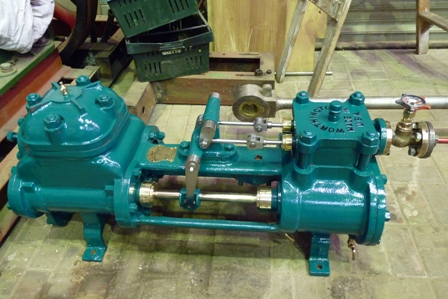
Worthington Pump
A duplex steam pump made by Worthington, U.S.A., which was rescued from the undergrowth outside, has had a complete make over, to make another fine exhibit for the museum. Like many other exhibits it will have to wait until more progress is made with the Clapham Road Beam Engine in order free up museum floor space.
Clapham Road Beam Engine - Update
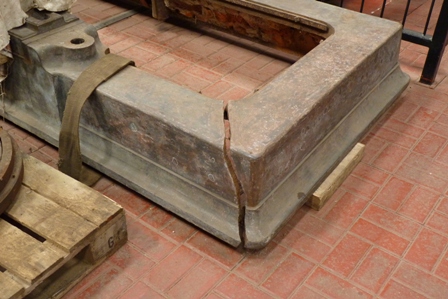
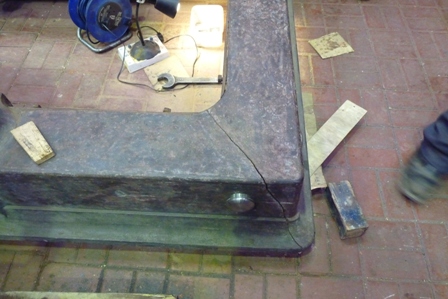
Progress with the restoration has been a hard slog, mainly cosmetic i.e. de-rusting, cleaning, polishing bright metal, painting etc. Building of the foundation walls is now finished and steel reinforcing and shuttering almost complete so that concrete can be poured, to form substantial columns, to support the RSJ sub-frame (also close to being finished). The cast iron bed-plate has two major cracks in it, which were discovered on site at Bedford. One of these is at one corner of the bed plate, at the crank end. During transit to the Museum, this crack opened up to form a break about 1ins. wide. Two threaded tie bars were made and fitted to pull the gap together from opposite directions.
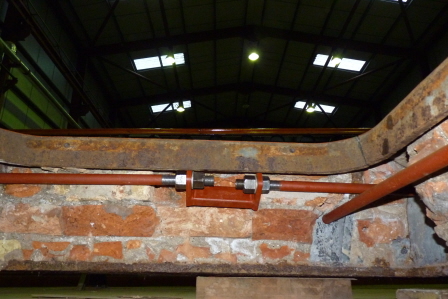
The brickwork, underneath, was very hard and difficult to remove, and probably formed part of the original 19th century foundations.
January 28th 2012
Two New Arrivals
The Museum has taken possesion of two more, marine connected, engines.
A steam driven capstan, built c.1942 by Emerson Walker Ltd., Gateshead.
A steam steering engine, built c.1942 by Donkin & Co. Ltd, Newcastle on Tyne.
These two engines came from the same ship, the Royal Fleet Auxiliary 'Throsk'. They were purchased, from Dingles Fairground Heritage Centre, Devon, using funds accumulated from visitor donations. A big thank you to all those who have donated.
In due course they will be dismantled and rebuilt to our usual standards.
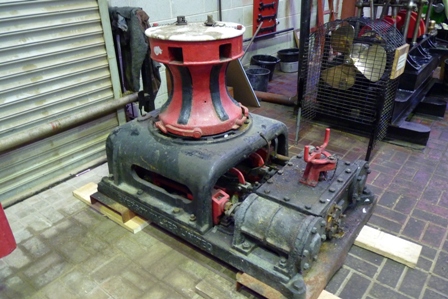
Worm driven, by a two cylinder steam engine.
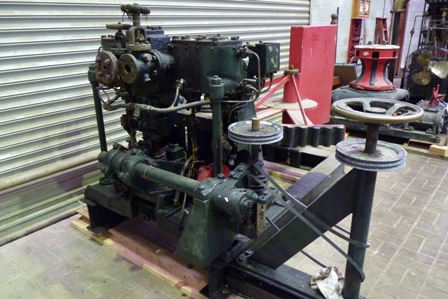
The red 'vane', you can see at the back,is a 'replica' rudder, which has been fitted to the engine at some time.
April 2012
Emerson Walker Steam Capstan
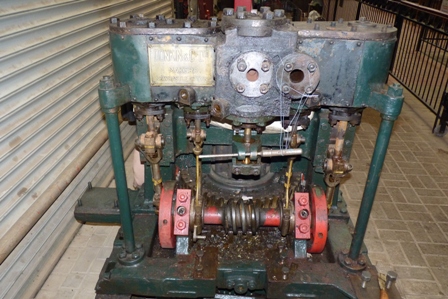
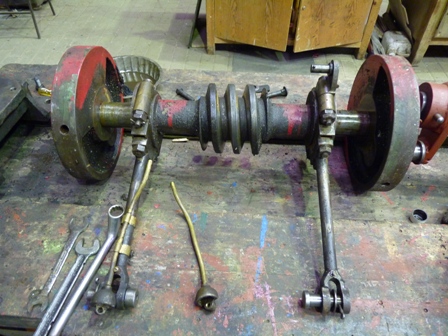
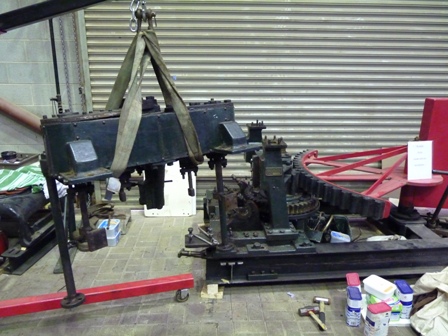
Donkin Steering Engine Dismantling work has started on both the capstan and the steering engine.
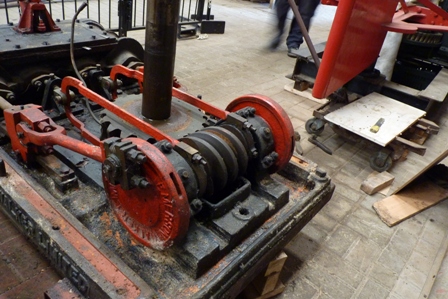
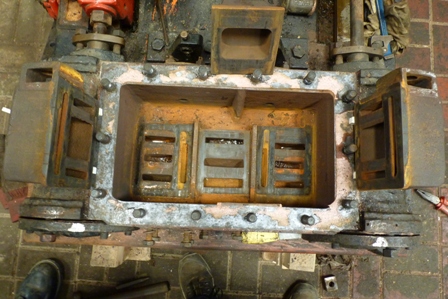
Inside steam/valve chest showing a rather clever arragement of ports, which enable reversing to take place, as an alternative to reversing linkage.
On the left and right are the cylinder valves.
Top centre is the reversing valve.
July 2012
Emerson Walker Steam Capstan
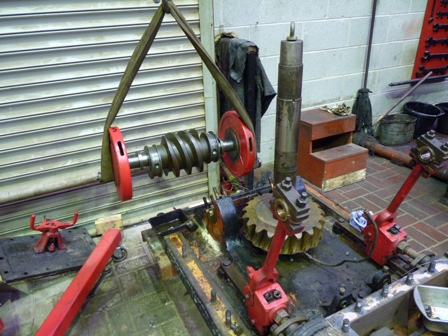
Donkin Steering Engine Both these engines have been completely dismantled ready for cleaning and restoration etc.
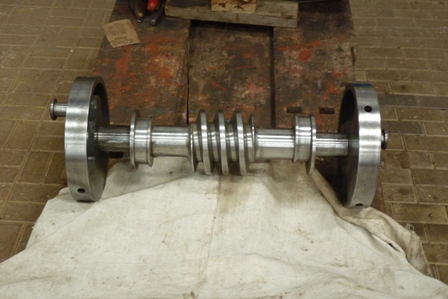
crankshaft cleaned up, ready for assembly.
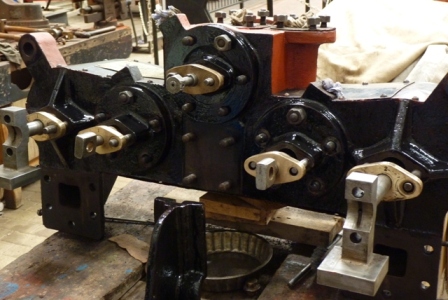
cylinder block cleaned up and painted.
Clapham Road Beam Engine
At last some progress has been made on the concrete foundation for this engine.
Shuttering and strengthening struts are in place, and about two thirds of the concrete has been poured, leaving around a depth of 3ft. yet to poured, once the sub-frame and foundation bolts are in place. The cavity to be filled between the concrete block walls, is in the most part, only 18ins. wide.
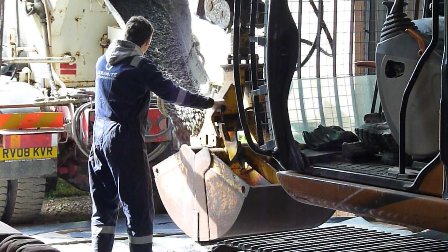
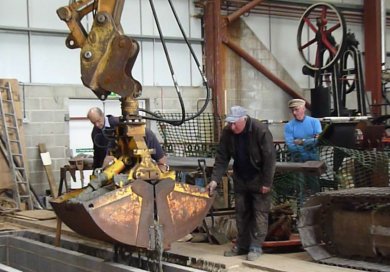
In order to have some control of the flow of liquid concrete during filling, a crane grab was used to transport the concrete from the mixer lorry. This worked very well but was time consuming.
November 2012 Emerson Walker Steam Capstan
Donkin Steering Engine
Steady progress has been made on the restoration of both these engines.
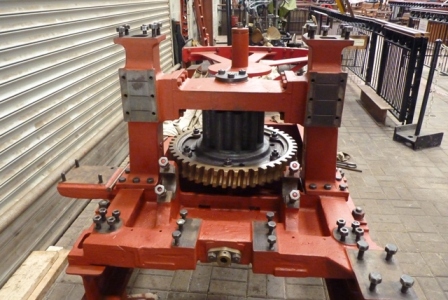
After all the cleaning etc. assembly of the engine has now started.
Clapham Road Beam Engine - Update
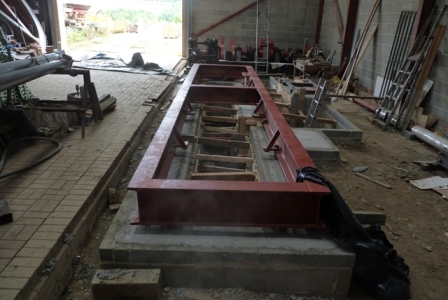
The 12ins. x 6ins. RSJ subframe has been completed and placed on the concrete block wall with its holding down bolts in place. The subframe was raised up about 4ins. to give room to pour the final batch of concrete.
Once the concrete had set and dried out the subframe was lowered onto the base and levelled up before securing with the holding down bolts.
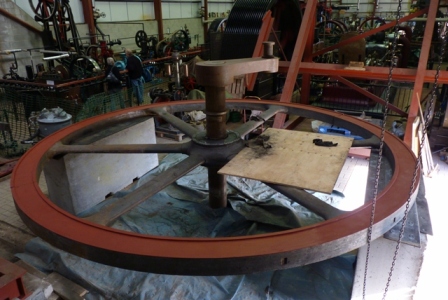
The flywheel has been removed from the frame, which was used to transport it from Bedford, and supported in the horizontal position. This will allow the removal of the remaing old paintwork, ready for a coat of primer. Assesment is still on going as how to machine the badly corroded main bearing journal.
Work has started on the cast iron framed entablature. Sometime after the engine's working life, one end of the entablature has been cut off. This has left the remaining end hanging over one side of the support columns. We need to balance this up by making some framework to bolt to the remaing part of the entablature so that it overhangs a similar amount on the other side.
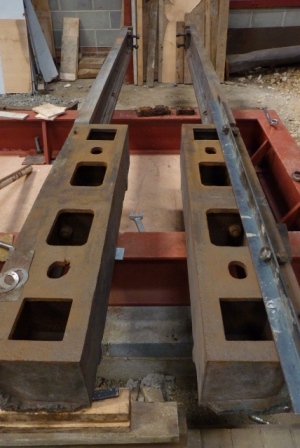
In the foreground (on the end of the box section) you can just see the jagged edges where the other ends have been cut off.
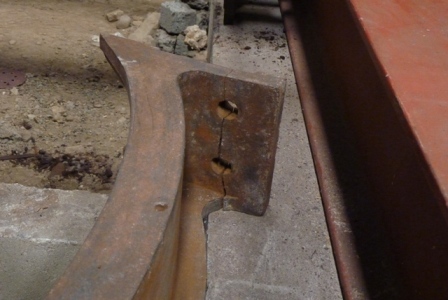
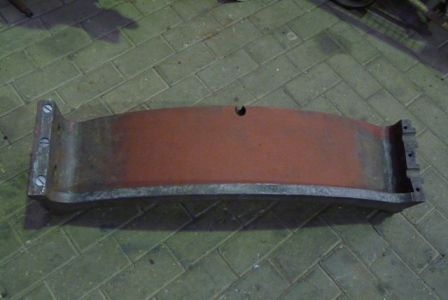
When the entablature was first dismantled the flanges, on the cast iron end piece, were found to be broken. A repair has been made by drilling and tapping the casting and then bolting the broken piece to it.