Side-Lever Marine Engine - Paddle Tug 'Reliant'
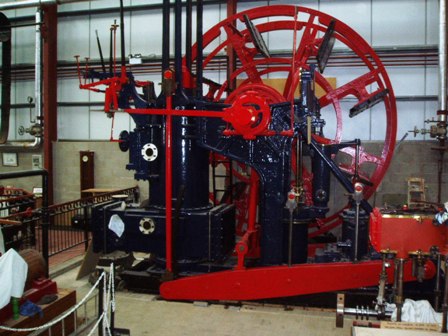
This engine, built in 1907 by Hepple & Sons of South Shields, was one of two engines fitted to the paddle tug 'Reliant' (previously called 'Old Trafford').
The engine in the museum is the port engine. The starboard engine has been fully restored, with a makeshift paddle wheel, and is on display in the National Maritime Museum, Greenwich, where it is turned over by electric motor.
The Side-Lever Marine Engine is basically a beam engine with two rocking beams, each one placed either side of the cylinder at the base of the engine. This has the advantage of reducing the overall height of the engine and lowering the centre of gravity, which makes it ideally suited to drive the paddle wheels of steamers and tugs etc.
These engines were popular during the mid 1800's until they were superseded by the more compact, fuel-efficient, high speed engines used to drive screw propeller vessels. The engines fitted to the 'Reliant' were of the grasshopper type, which was a modified design introduced later, where the side-levers are pivoted at one end rather than in the centre of the lever. In addition to driving the paddle wheels the side levers also drive various pumps.
(i) The air pump, which maintains the vacuum in the condenser.
(ii) The boiler feed pump which maintains the water level in the boiler.
(iii) The bilge pump, which removes water that accumulates in the bottom of the boat.
(iv) The cooling water pump, which forces cold water through the condenser, to cool the steam and create a vacuum.
It is unusual to see an example of this type built and installed as late as 1907.
Technical details
| Type of Engine | Single cylinder, surface condensing, side-lever marine engine |
|---|---|
| Builder & Year | Hepple & Sons of South Shields 1907 |
| Cylinder Sizes | 30 ins diameter |
| Stroke | 54 ins. |
| Valves | Slide valve, with an expansion valve is fitted in the same steam chest. |
| Other Information | The end of the piston rod is connected to a cross-head yoke, which slides in vertical guides above the cylinder. Each end of the yoke is connected to one end of the respective side-levers, by long rods. Further along the side-levers is the pivot for a connecting rod, which drives an overhead crank on the paddle shaft. |