Ship's Capstan Engine - RFA 'Throsk'
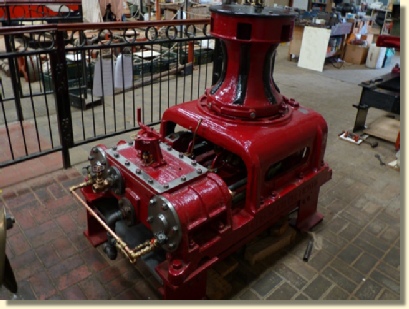
Built in 1942 by Emerson Walker Ltd., of Newcastle on Tyne
A two cylinder horizontal steam engine driving a vertical capstan drum through worm and wheel gearing.
The engine is from the Royal Fleet Auxiliary ship ‘THROSK’ and bears the stampings to that effect. There is no builder’s plate but the makers name is cast on the sides of the bedplate. The cylinder block pressure test, dated 10/2/43, is stamped on the casting.
The engine No. Is very probably 8325.
It was purchased by Markham Grange Steam Museum Association, along with the steering engine from the same ship, and arrived at the museum on 28th January 2012.
The engine castings are abnormally rough in finish, which is assumed to be a result of war time economy, urgency and labour shortage. There is also evidence of a repair to the bedplate casting, just below the cranks. In peacetime the casting would probably have been scrapped and would not have left the foundry.
After the ship was scrapped at Grays, Essex. C1982:
The owners were :-
J Newnham, near Chelmsford, Essex, c1982 - c1995
Then Dingles Steam Village in Devon c1995 - January 2012
The engine has been completely dismantled and re-built.
First steaming at the museum was 20th August 2014
(GCD September 2014)
Technical details
| Type of Engine | Horizontal, two cylinder engine |
|---|---|
| Builder & Year | Emerson Walker Ltd., Newcastle on Tyne; 1942 |
| Cylinder Sizes | 6 ins. Diameter |
| Stroke | 8 ins. |
| Valves | Slide valves, driven by eccentrics on crankshaft |
| Other Information | Two or more of these capstans would have been on the ship, but no evidence of this, so far, has come to light. The engine has two full-pressure cylinders with quartered cranks, enabling it to start from any position. The cylinder slide valve eccentrics are at 90 degrees to the cranks (ie without lap or lead), and a control valve between the two cylinder-valves enables it to run in either direction. This is achieved by making both cylinder-valves work as either outside or inside admission, using suitable steam and exhaust passages in the base of the main valve-chst casting. The engine can be reversed by a lever and cam in the top cover of the valve chest, which moves the control valve forward or back. The capstan drum can be disconnected and freed from the engine by lifting out two driving pins on the top. The drum can then be manually rotated by inserting long bars into the square holes in the top rim. Ratchet levers, engaging in notches in the base casting, are lowered to prevent rotation against manual operation. |